“The Phenomenology of Computation.” 2026, Brooklyn, NYC.
A talk that explores how we experience and live in a strongly designed, i.e., highly computed world. I believe this is important for technology creators, as we are critically contributing to the experiences people have in their lives.
The talk is grounded in key works of media theory, Heidegger’s thinking on technology and contemporary theoretical perspectives. These are brought together to examine what it means to live in a strongly designed world, what it means to live at a distance from an original and how these questions resonate today. Developed in dialogue with media theorist Alexander Galloway (NYU), the talk was presented as part of the Meta NYC Tech Talk Series on January 29th, 2026.
Following a high-resonance internal session with nearly 100 practitioners at Meta NYC, I am now sharing the core artifacts. See below the recording of the talk and the slides, please reference when using these materials in your work.
The slides: Please open the speaker notes to follow the content
The Dialog: Trace from the Q&A
The Question of Manufactured Intention:
The Tension: How do we navigate a world where ranking models "manufacture" our intentions, steering us away from the organic and intuitive? Can we "wind back the clock"?
The Reflection: We cannot wind back the clock, but we can "open the casing". By applying Hegel’s Phenomenology of Spirit, we move from a state of being steered to a state of knowing that we know. Awareness of the mediation, the physical "gears" underneath the glossy interface, reduces the pressure of the "Silent Anxiety".
The Asymmetry of Traceability (The "Honey Crisp Apple" Problem):
The Tension: If those inside the machine can trace the "Honey Crisp" apple back to the "Original" but those outside cannot, how do we bridge that gap?
The Reflection: This is the ethical challenge of our era. While a "Policy of Description" (where every interface must describe its own production) may be a distant dream, we must look to Media Theory for answers. By treating engineering as a poetic act that reveals rather than hides, we can start to build "breadcrumbs" back to the original for the user.
Personal Reflection: The Human Stake
The motivation for this work isn't just academic, it’s personal. I see the tension in how my own family interacts with these interfaces. When we move the public discussion from "Privacy" to "Protocol" we stop arguing about single threads and start addressing the fabric of our computed lives.
If you are interested in joining the continued 'Theory & Practice' dialogue around these protocols, please reach out.
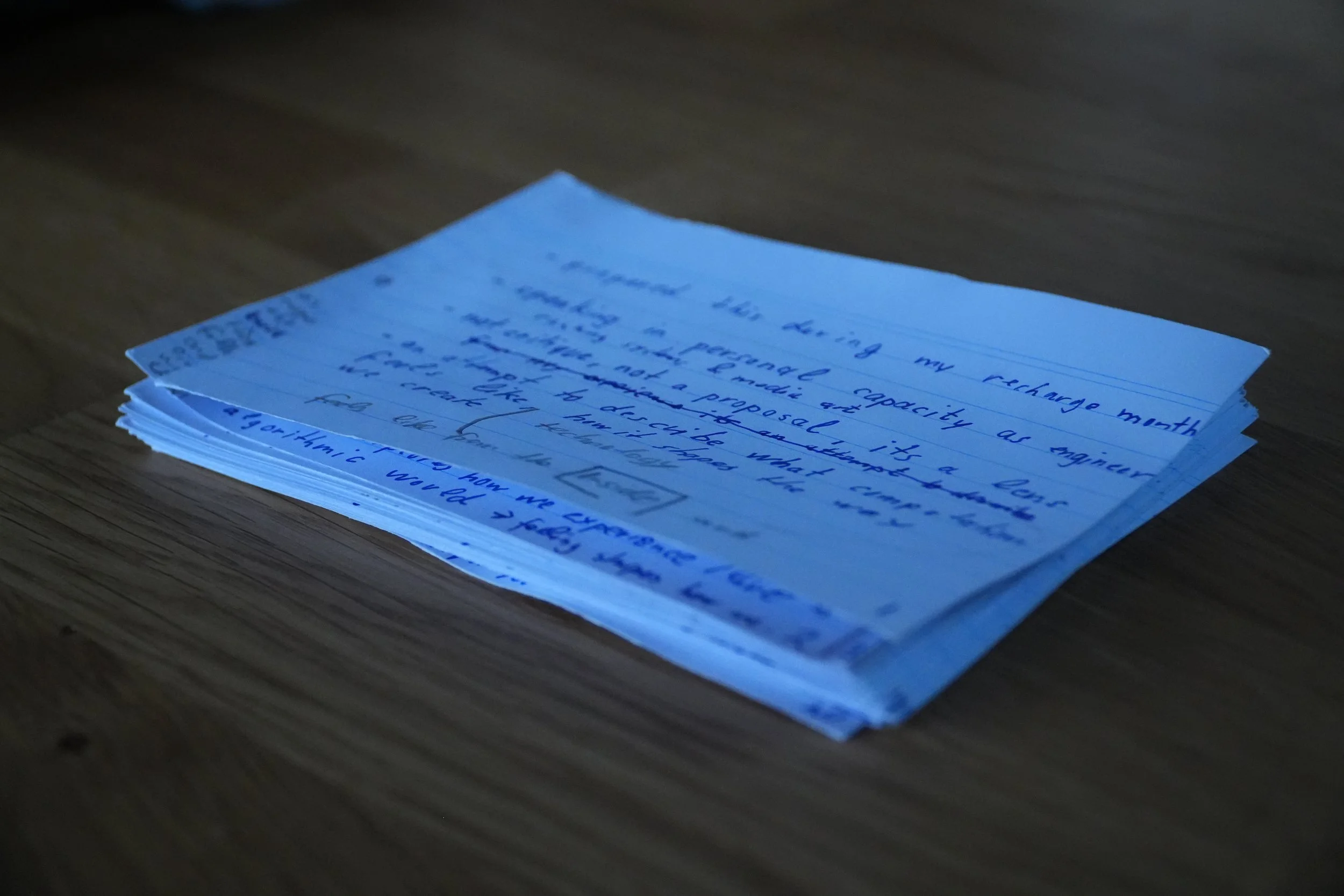
Special thanks to Marco Zamarato, Sean Catangui and Michael Hogger for their invaluable feedback during the very early stages of this presentation. Their willingness to stress-test these ideas in their messiest form made the final talk possible.